A solo flight can mark a major milestone on the path to professional aviation, but it is only one part of a commercial pilot’s preparation.
Understanding how solo experience fits with cross-country flying, total flight time, and structured instruction helps you plan training with purpose. Each contributes to the broader progression toward professional certification.
This guide explains how these requirements fit together and how pilots build experience along the way. You’ll get a clearer picture of the training pathway and the decisions that shape your next steps.
Key Takeaways
- Under FAA Part 61, airplane commercial pilot applicants need at least 250 total flight hours, according to the Federal Aviation Administration.
- For a single-engine airplane rating, the solo requirement can also be met by performing pilot-in-command duties with an authorized instructor on board.
- Plan for a qualifying cross-country flight of at least 300 nautical miles, with landings at three points, according to the Federal Aviation Administration.
- Commercial training includes required experience across applicable areas of operation, not just solo and cross-country flying.
- Structured flight instruction and experience-building can help you progress toward commercial pilot certification and future career goals.
What Is the Commercial Pilot License?
A U.S. commercial pilot certificate recognizes advanced flight experience and training for the privileges associated with its aircraft rating. Under FAA Part 61, an airplane commercial pilot applicant must have at least 100 hours of pilot-in-command time, according to the Federal Aviation Administration. Pilot-in-command, or PIC, time is logged when the pilot is responsible for the flight’s operation.
Outside the United States, commercial pilot flight-time requirements are set by each country’s aviation authority, not automatically by FAA Part 61. Requirements therefore vary by jurisdiction, certificate, and aircraft category; FAA hours shouldn’t be assumed to transfer unchanged.
The 100-hour PIC figure is only one part of the experience requirements. For an FAA Part 61 airplane commercial pilot certificate, the required PIC time includes at least 50 hours of cross-country flight, with at least 10 of those hours in airplanes, according to the Federal Aviation Administration. Cross-country time records flights between locations, building experience in navigation and flight planning.
The FAA also specifies a qualifying long-distance cross-country experience point. At least one point must be at least 250 nautical miles in a straight line from the departure point, according to the Federal Aviation Administration. This is a straight-line measurement, not necessarily the aircraft’s total route distance.
Solo time and PIC time are related, but they aren’t identical in every training scenario. For a single-engine airplane rating, an applicant may log 10 hours of solo flight in a single-engine airplane or perform PIC duties with an authorized instructor on board for 10 hours, according to the Federal Aviation Administration. The solo flight time requirements for a commercial pilot must be considered alongside the full PIC and cross-country record.
The FAA’s solo or PIC-with-an-instructor experience also includes specific night and airport tasks. According to the Federal Aviation Administration, the experience includes 5 hours of night VFR and 10 takeoffs and 10 landings at an airport with an operating control tower. Night VFR means flying under visual flight rules at night.
- PIC experience: At least 100 hours for an airplane applicant under Part 61.
- Cross-country PIC: At least 50 hours, including at least 10 hours in airplanes.
- Long-distance point: At least one point 250 nautical miles straight-line from departure.
- Night and tower experience: 5 hours of night VFR, plus 10 takeoffs and 10 landings at an operating control tower airport.
These figures describe distinct parts of the FAA experience framework, not interchangeable hour categories. Your logbook should show what each flight counts toward, including aircraft type, pilot-in-command role, route, and conditions. For example, a cross-country flight may count toward PIC experience when you act as pilot in command, but the route and aircraft details still determine whether it satisfies a specific requirement.
Solo training time and cross-country requirements
Cross-country planning tests your ability to manage a flight beyond the local training area. Route selection, navigation, weather decisions, and accurate records all affect whether a flight supports a specific experience requirement.
Solo Time Across Aircraft Ratings
Solo experience must match the aircraft rating you’re pursuing. Record single-engine and multi-engine flights separately: experience in one category does not replace the other’s specific requirements. This distinction helps you plan aircraft use and identify experience you still need to gain.
For solo flight time requirements for a commercial pilot, organize logbook entries by aircraft category and your role on each flight. Clear records distinguish solo operation from PIC duties performed with an instructor aboard, making a training review more precise.
The required FAA commercial-pilot solo or PIC-with-an-instructor experience includes a cross-country flight of at least 300 nautical miles total, with landings at three points, according to the Federal Aviation Administration. Plan the route around those landing points and document each stop and the completed distance.
Route planning involves practical decisions. Review weather along the route, identify suitable alternatives, and consider how conditions could change before your return. If forecast conditions affect a planned stop, evaluating an alternate route before departure supports safer decision-making and a clearer flight plan.
Solo endorsements define the limits of an authorized flight. Review your instructor’s endorsement before departure, including any route, aircraft, or operating limitations. If the plan changes, don’t assume the original endorsement covers it. Resolve the difference with your instructor before flying.
Counting Solo Hours Toward the Minimum
Solo flights add to logged experience, but what they count toward depends on the category and purpose recorded. Each entry should accurately identify the aircraft, route, and your role so it can be assessed against the applicable training requirement.
Understand solo flight time requirements for a commercial pilot through organized records, not one undifferentiated total. Reviewing entries by aircraft type, for example, can show whether cross-country and rating-specific experience are documented separately.
- Separate logbook entries by aircraft category and pilot role.
- Record the route, landing points, and completed flight details.
- Review endorsement limitations before departing on a solo flight.
For Hawaii, the FAA commercial-pilot cross-country requirement calls for a longest leg of at least 150 nautical miles in a straight line. Helicopter applicants need Ten hours solo or PIC duties with an authorized instructor on board; gyroplane applicants have the same Ten-hour solo-or-PIC alternatives.
Commercial pilot total flight time
A commercial pilot’s accumulated flight time grows through several stages, starting with private training and continuing into advanced instruction. In the United States, private pilot applicants need at least 40 flight hours, including at least 20 hours of flight training with an instructor. Those hours begin building the experience later reviewed for commercial certification.
The minimum for private certification doesn’t necessarily match the time a student actually logs. Most U.S. private pilot students log closer to 60 to 70 flight hours before passing the checkride. That difference illustrates why a training plan should use completed logbook time, not only certificate minimums, when estimating the experience still needed.
Treat your total as a running record, then review its components separately. Sort entries by aircraft, instructor involvement, solo operation, and cross-country purpose. Earlier private-pilot training flights remain part of your history, while later commercial lessons add new entries and develop more advanced skills.
Good recordkeeping starts with each flight. After a lesson, enter the date, aircraft identification, route or activity, and relevant time categories in your logbook. Compare the entries with your training plan to catch missing details before an instructor reviews your progress toward the next certificate.
- Start with prior experience: Gather private-training and later flight records.
- Separate categories: Sort entries by aircraft, role, and flight purpose.
- Review the record: Compare completed experience with the next training objective.
- Keep entries current: Document each flight while its details are clear.
If you completed private training and later added instrument lessons, include both stages in your accumulated record. Instrument training develops skills for operating by reference to cockpit instruments, while earlier flights remain part of your history. Record the nature of each flight accurately rather than treating every entry as identical.
Flight-time totals also help with career planning after a commercial certificate. An organized record can help you identify suitable next steps, such as additional qualifications or instructor training. Distinguish total logged time from experience that meets a particular training objective: the total alone doesn’t show which skills you’ve practiced.
Review your records at each training milestone. Before starting a new phase, gather the relevant logbook entries and note which flight activities you’ve completed. This preparation makes instructor discussions more specific and connects upcoming flights to a deliberate training progression.
Flight instruction and career time-building
Commercial training combines required instruction with experience that develops sound judgment. For a U.S. commercial pilot certificate with a single-engine airplane rating, the applicant must complete 20 hours of training on the applicable areas of operation, according to the Federal Aviation Administration. These areas connect flight skills with the decisions pilots make before and during each flight.
Specific lessons address different parts of commercial flying. Part 61 training includes 10 hours of instrument training using a view-limiting device. This device restricts outside vision, requiring the pilot to rely on instruments. The training builds instrument interpretation and control skills while an instructor supervises the lesson.
Preparation for the practical test also has a defined timing window. Part 61 training includes 3 hours in a single-engine airplane with an instructor, completed within the 2 calendar months before the test. That preparation gives the applicant time to rehearse test tasks and identify areas needing focused practice. The flight should be planned as test preparation, not simply logged as routine experience.
After earning a commercial certificate, some pilots pursue flight instructor certification to continue developing experience. Instructing involves explaining procedures, observing another pilot’s performance, and managing a flight while teaching. The role turns your own training into structured practice in communication, planning, and decision-making.
Build hours with a clear purpose. Identify which flights support training objectives, provide cross-country experience, or contribute to a future career goal. Record the aircraft, flight conditions, route, and your role for each entry. These details make your logbook more useful for reviewing progress and planning what comes next.
- Review required training: Track the 20 hours across applicable areas of operation.
- Develop instrument skills: Include the specified 10 hours using a view-limiting device.
- Prepare near the test: Schedule the 3-hour instructor flight within the required window.
- Consider instructing: A flight instructor role can combine teaching with continued flying experience.
Training pace varies with lesson frequency and individual progress. For example, a student flying two to three times per week might earn a Private Pilot License in six to nine months. This describes private training, not a guaranteed timeline for a commercial certificate. Regular lessons can maintain continuity, but each stage still requires completion of its own training and experience requirements.
Long-term planning can connect a commercial certificate to later career milestones. The FAA Airline Transport Pilot certificate requires 1,500 total flight hours. A flight instructor path is one way pilots build experience after commercial training, while continuing to strengthen instruction, communication, and operational judgment.
Part 61 total flight-time minimum
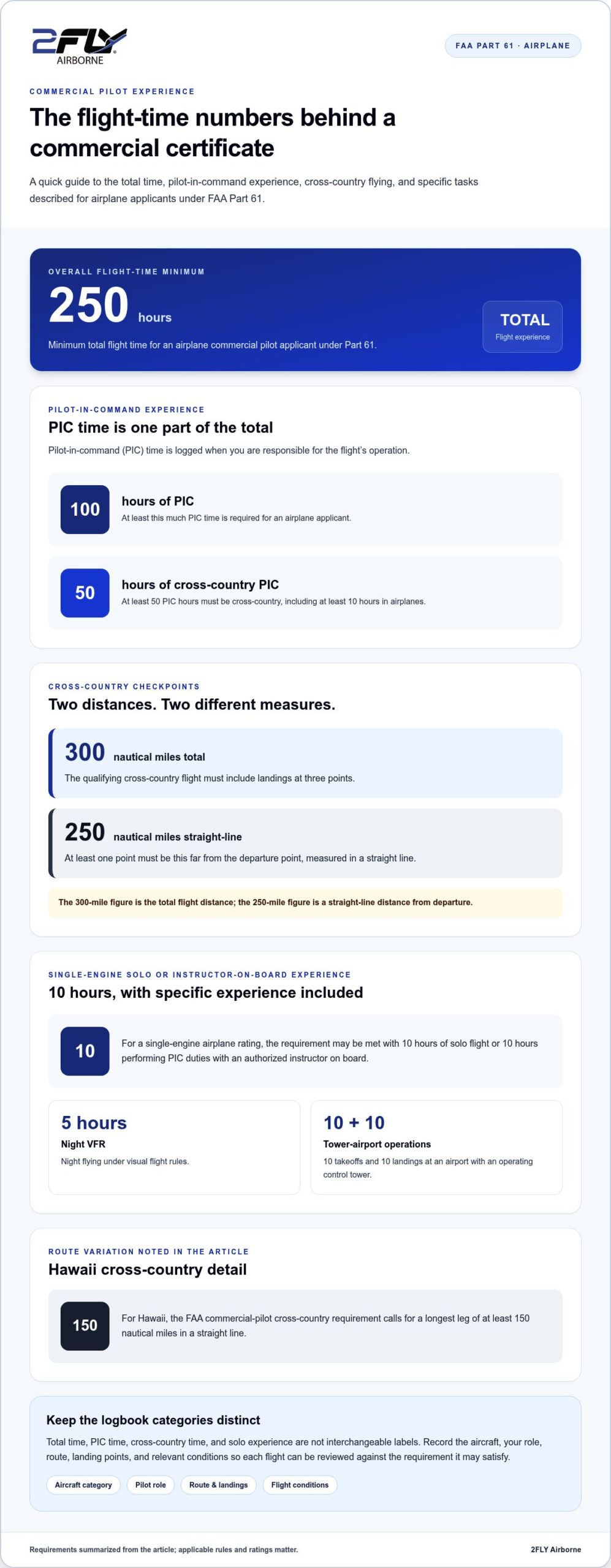
The FAA aeronautical experience requirements combine total time, pilot-in-command experience, cross-country flying, and specific training tasks. Under FAA Part 61, an airplane commercial pilot applicant must log at least 250 hours of total flight time, according to the Federal Aviation Administration. The exact experience categories depend on the certificate and airplane rating sought.
For a single-engine airplane certificate, at least 50 of the 250 required hours must be in airplanes. The requirement also includes at least 100 hours of powered-aircraft time, including at least 50 hours in airplanes. These nested categories matter: airplane hours contribute to powered-aircraft time, rather than being an additional amount beyond it.
Part 61 also calls for experience in particular aircraft or equipment. Commercial training includes 10 hours in a turbine-powered, complex, or technically advanced airplane, or a combination of those aircraft. A technically advanced airplane uses specified advanced avionics, so pilots should distinguish qualifying aircraft time from ordinary airplane time in their records.
Some flight tasks add structure to the total. Part 61 includes a daytime cross-country flight lasting 2 hours in a single-engine airplane and covering more than 100 nautical miles in straight-line distance from departure. This requirement gives the applicant experience planning and completing a longer daytime route, beyond local practice flights.
Compare training frameworks before estimating your remaining time. An approved FAA Part 141 commercial course can reduce the total flight-time requirement to 190 hours, while the Part 61 airplane minimum is 250 hours. The Part 141 figure applies to an approved course, not simply to any training conducted by a school.
- Separate hour categories: Track total time, powered-aircraft time, and airplane time distinctly.
- Identify qualifying experience: Note aircraft type and training task for specialized airplane requirements.
- Compare course rules: Determine whether your path follows Part 61 or an approved Part 141 course.
- Review flight records: Use logbook entries to identify completed experience and remaining requirements.
A flight may count toward more than one applicable category, but the details matter. A qualifying airplane flight, for example, may add to total time and airplane time. The aircraft and purpose determine whether it also satisfies a specialized training requirement. Accurate entries help you and your instructor assess progress without treating every logged hour as interchangeable.
The Part 61 minimum is a planning baseline, not a complete measure of readiness. Applicants must also meet the applicable training and experience criteria before the practical test. Organize your records by category, then compare each requirement with completed flights to see where focused training remains.
2FLY Airborne: FAA Professional Pilot Program
2FLY Airborne’s FAA Professional Pilot Program connects foundational training with the commercial pilot certificate pathway. It’s a practical next step for aspiring pilots who want structured progression through the Private Pilot Certificate (PPL), Instrument Rating (IR), and Commercial Pilot Certificate (CPL).
Understanding solo, cross-country, and total flight-time requirements helps you discuss your training goals clearly. The sequence matters: each certificate and rating builds skills and experience for the next stage. A training advisor can explain how the FAA Professional Pilot Program’s stages relate to your career goals.
For a focused conversation about your path toward commercial certification, contact 2FLY Airborne.
Turn Your Training Goals Into a Clear Next Step
Turn the requirements into a practical training plan. Review your logbook with an instructor, identify the experience you still need to build, and connect each upcoming flight to a clear learning objective. This keeps your progress purposeful as you work toward professional aviation.
Understanding the solo flight time requirements for a commercial pilot is one part of planning; applying them to your own training history makes the information useful. Bring your questions about flight experience, certificates, and career direction into a focused conversation with a training advisor.
Contact 2FLY Airborne to discuss your training and consider the next stage of your aviation journey. With a clear plan and disciplined preparation, you can keep moving toward your professional goals with confidence.
Frequently Asked Questions
How Many Flight Hours Do You Need to Become a Pilot?
It depends on the certificate you’re pursuing and the training path you follow. In the United States, a private pilot certificate has a 40-hour minimum; an airplane commercial certificate requires 250 hours under Part 61, while an approved Part 141 course can have a 190-hour minimum. The Airline Transport Pilot certificate requires 1,500 total flight hours. For example, someone aiming to teach or fly professionally needs to plan beyond private certification.
How many solo flight hours are required for a commercial pilot certificate under FAA Part 61?
For a single-engine airplane rating, the requirement is 10 hours solo or 10 hours performing pilot-in-command duties with an authorized instructor aboard. These alternatives aren’t the same as simply logging any 10 flight hours. For example, a flight with an instructor counts toward the alternative only when the applicant performs the PIC duties. Record the aircraft and role clearly in the logbook.
What solo cross-country flight requirements apply to a U.S. commercial pilot certificate?
The qualifying solo or PIC-with-an-instructor cross-country flight must cover at least 300 nautical miles total and include landings at three points, according to the Federal Aviation Administration. Separately, the commercial cross-country experience includes a point at least 250 nautical miles straight-line from departure. These are distinct route measures. Before departure, map the route and planned landings, then document the completed flight accurately.
How many solo flight hours are required under FAA Part 141 commercial pilot training?
For a single-engine airplane rating, the solo experience requirement is 10 hours, or 10 hours performing PIC duties with an authorized instructor aboard, according to the Federal Aviation Administration. Part 141’s 190-hour figure refers to total flight time for an approved commercial course, not solo time alone. A student should track course flight time by role and aircraft, so solo experience isn’t confused with the total-hour minimum.
How do commercial pilot solo-hour requirements differ for airplane single-engine and multi-engine ratings?
Both ratings require 10 hours either flying solo or performing pilot-in-command duties with an authorized instructor on board. The hours must be logged in the relevant aircraft: single-engine time for the single-engine rating and multiengine time for the multiengine rating.
Article by
2FLY Airborne
2Fly Airborne is a professional flight training organization dedicated to developing the next generation of skilled, confident, and safety-focused pilots. With decades of combined aviation experience, our team of certified instructors provides structured, real-world training designed to prepare students for both checkrides and long-term success in the aviation industry.
Content Disclaimer
Some blog content is generated with the assistance of automated tools and may not always be fully accurate or up to date. Please verify all aviation-related information with official sources or a certified instructor. For additional guidance or clarification, we encourage you to contact one of our training advisors at 2Fly Airborne.