Planning a route to a commercial pilot certificate? The training path matters as much as the final hour total. According to the Federal Aviation Administration, an airplane commercial course under Part 141 requires at least 120 hours of flight training, while the Part 61 route requires at least 250 total flight hours. An approved Part 141 path can bring the total to 190 hours. A comprehensive commercial pilot syllabus under Part 141 organizes training into stages, lessons, and completion standards.
It’s easy to focus on the headline hour total when comparing training options. But that number alone does not show how dual instruction, solo flying, ground study, and practical-test preparation build commercial-level skills.
This guide explains how flight-hour requirements fit together, what dual and solo time contribute, and how a syllabus structures your progress. You’ll also see why lesson counts and stage standards provide a clearer picture of the work ahead than a single total, helping you plan your next step toward a commercial pilot certificate.
Key Takeaways
- According to the Federal Aviation Administration, a Part 141 commercial airplane course requires at least 120 hours of flight training.
- An approved Part 141 path can bring the total flight time to 190 hours, compared with 250 hours for the Part 61 commercial route.
- Look beyond the total: dual instruction and solo flying serve different purposes in building commercial-level skills.
- Use the syllabus stages and lesson standards to understand how training progresses and what each phase is designed to develop.
- See how 2FLY Airborne’s FAA Professional Pilot Program connects private, instrument, and commercial pilot training.
Can I Do Part 141 Commercial Training with Fewer Hours?
Yes. A Part 141 course can require fewer total flight hours than the Part 61 commercial route, but the course still has defined minimums and standards. The syllabus connects flight time, instruction, checks, and test preparation into one structured program.
Part 141 Course Flight Hours
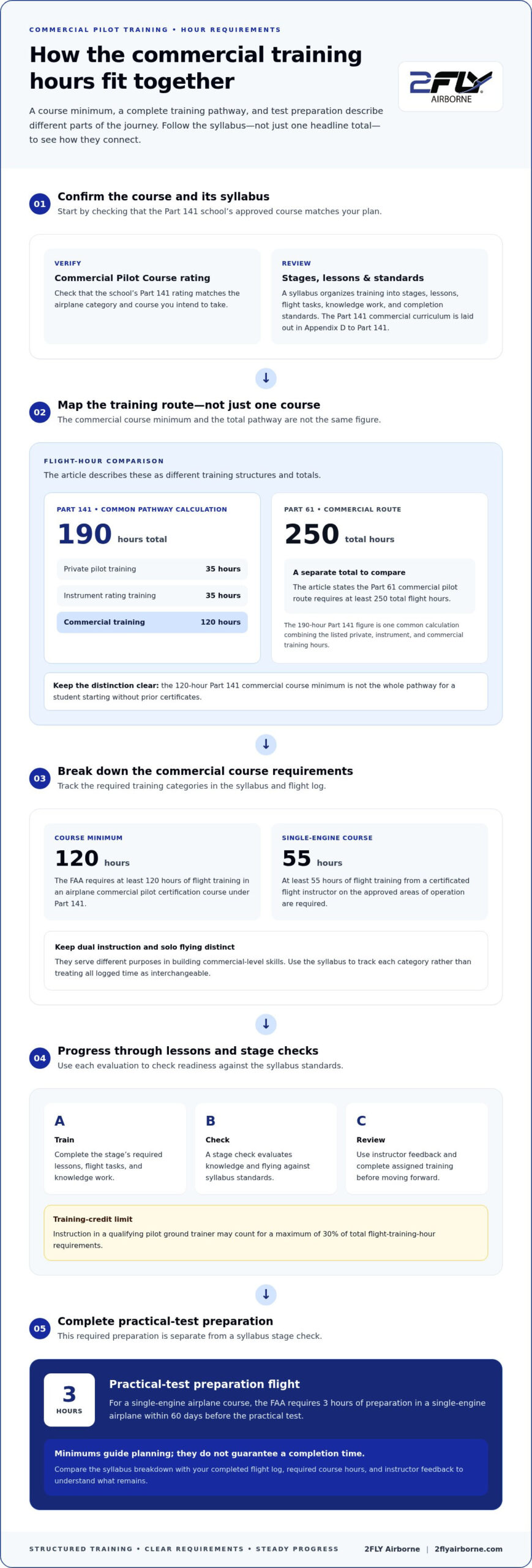
A Part 141 course flight-hour requirement is the minimum training time assigned to a specific certificate course. According to the Federal Aviation Administration, an airplane commercial pilot certification course must include at least 120 hours of flight training. By comparison, the Federal Aviation Administration states that the Part 61 commercial pilot route requires at least 250 total flight hours.
The 120-hour course minimum is not the whole pathway for a student starting without prior certificates. One common Part 141 calculation adds 35 hours for private pilot training, 35 hours for instrument rating training, and 120 hours for commercial training, producing a 190-hour pathway. Training credit also has limits: according to the Federal Aviation Administration, instruction in a pilot ground trainer meeting 14 CFR §141.41(a) may count for a maximum of 30 percent of total flight training hour requirements.
For a single-engine airplane course, the Federal Aviation Administration requires at least 55 hours of flight training from a certificated flight instructor on the approved areas of operation. It also requires 3 hours of practical-test preparation in a single-engine airplane within 60 days before the test. These figures describe course requirements, not a promise that every student will finish at the minimum.
Stage Checks and End-of-Course Tests
A stage check is a progress evaluation used to assess a student’s knowledge and flying against syllabus standards. Part 141 commercial courses have defined stages and completion standards, so each check helps identify whether the student is prepared to advance.
Use the syllabus to track each stage’s required lessons, flight tasks, and knowledge work. The final practical-test preparation is distinct from a stage check: the Federal Aviation Administration requires the 3-hour preparation flight within 60 days before the test. A student should review instructor feedback and complete any assigned training before moving forward.
School Approval and Syllabus Verification
A commercial pilot course rating identifies the course a Part 141 pilot school is approved to conduct. Under 14 CFR Part 141, §141.11, a school may be issued a Commercial Pilot Course rating; the curriculum is laid out in Appendix D to Part 141. Check that the school’s rating matches the airplane category and course you plan to take.
A syllabus is the course plan that organizes lessons, stages, and completion standards. Compare its flight-hour breakdown with the 120-hour minimum, and look for the 55 instructor-led hours and the practical-test preparation requirements. These details make the course materials useful for tracking progress rather than simply listing lessons.
What is the average cost of Part 141 commercial pilot training in the United States? Price depends on the aircraft, instructor time, training pace, and additional instruction; the price is provided after a quote request.
How do I find an FAA-approved Part 141 school and verify its commercial pilot course syllabus? Look for a Part 141 school with a Commercial Pilot Course rating, then compare its syllabus with Appendix D and the course requirements. A comprehensive commercial pilot syllabus under Part 141 should make its stages, flight-hour categories, and completion standards clear.
Commercial pilot minimum flight hours
A minimum flight-hour requirement is the least amount of training time assigned to a certificate or course. For commercial training, course requirements and certificate prerequisites shape the overall pathway. Track each category in the syllabus instead of treating all logged time as interchangeable.
Commercial course minimum
A commercial course minimum is the required flight training within the commercial course itself. Part 141 does not explicitly specify one minimum total flight time for the complete commercial route described here. Instead, the syllabus sets course requirements, while prior certificates and ratings form separate parts of a pilot’s training record.
This distinction matters when comparing a course minimum with a student’s total flight time. A private pilot certificate and instrument rating involve their own training before commercial lessons begin. Stage checks assess progress against the syllabus, but do not replace required flight time.
For planning, identify which hours apply to each certificate, rating, and commercial course. Your flight log records completed experience; the syllabus shows how lessons and stage checks fit together. Review both to see which requirements are complete and what remains.
Private pilot minimum flight hours
A private pilot minimum is the required flight training for the private pilot certificate. The listed Part 141 private pilot course requires 35 flight hours, while the listed Part 61 private pilot route usually requires 40 flight hours.
These figures describe different training structures, not a guaranteed completion time for every student. Before commercial training, confirm that your logbook and certificate records reflect the private-pilot training you have completed. Then map that experience against the commercial syllabus and its prerequisites.
An instrument rating is a separate qualification, not a substitute for private-pilot hours. Keeping rating and certificate records distinct makes it easier to track progress toward the commercial certificate without double-counting course requirements.
Cross-country and night flight requirements
Cross-country flight is planned travel between airports that meets the applicable course criteria. For commercial airplane training outside Hawaii, the required solo cross-country flight includes landings at a minimum of three points and a segment at least 250 nautical miles straight-line distance.
Night flight means flying during night conditions specified by the syllabus. The listed single-engine Part 141 course includes at least 5 hours of solo flight in night VFR conditions, with 10 takeoffs and 10 landings at an airport with an operating control tower. Stage 4, Module 3 also specifies 2.0 hours of solo night cross-country flight.
Keep night and cross-country entries clearly identifiable in your flight records. The listed course does not require 50 hours of pilot-in-command cross-country time. That distinction helps prevent confusion between a broad experience figure and the specific solo tasks assigned in the syllabus.
Commercial pilot dual and solo hours
Dual hours are flight time with an instructor, while solo hours are flights completed alone under the course’s conditions. In the listed Part 141 commercial course, the syllabus allocates 55 hours to dual training and 65 hours to solo training, together accounting for its 120-hour course total.
Dual instruction: practice with an instructor
Dual instruction is flight training completed with a certificated flight instructor. The instructor can demonstrate a maneuver, observe your execution, and give feedback during the lesson. This supervised practice builds and evaluates skills in the approved areas of operation for the commercial pilot certificate.
The syllabus divides dual time into lessons rather than treating it as one block. For example, Stage 4, Module 4 lists 2.0 hours of dual local flight, including 0.4 hours of instrument instruction. Stage 4, Module 6 lists 2.5 hours of dual local flight, also including 0.4 hours of instrument instruction. These module entries show how a course can combine local flight practice with focused instrument work.
Use each lesson’s objectives to prepare before flying. Review the assigned material, identify the maneuvers for the lesson, and note instructor feedback afterward. This connects ground preparation with aircraft performance and gives your next dual lesson a clear focus.
Solo flight: demonstrate independent control
Solo flight is a syllabus flight completed without an instructor onboard. It lets you apply learned procedures independently while meeting the course’s assigned conditions. Solo entries can cover different tasks, so record the module and flight purpose clearly.
Stage 2, Module 2 specifies 8.0 hours of solo cross-country flight, while Stage 2, Module 5 specifies 7.0 hours of solo long cross-country flight. Those are separate syllabus assignments, not interchangeable labels. Stage 4, Module 1 adds 1.5 hours of solo night flight, giving the student a distinct night-flying task.
Before each solo lesson, use the syllabus to identify its route, conditions, and completion objectives. Afterward, compare your flight record with the assigned module. Clear records make it easier to track course progress and prepare for stage checks.
How to read the dual-and-solo breakdown
A course-hour breakdown shows how the syllabus distributes training between instructor-led and solo work. The listed 55 dual hours and 65 solo hours describe that course’s allocation; they don’t mean every lesson has the same format or objective.
Compare individual modules instead. Stage 4, Module 4 emphasizes dual local flight, while Stage 2, Module 5 assigns solo long cross-country flying. Reviewing those entries before training helps you prepare for the correct task and understand how each flight contributes to course completion.
Commercial pilot syllabus lesson count and stages
A Part 141 syllabus organizes commercial training into stages, modules, lessons, and completion standards. Use that structure to follow progress toward the pilot certificate, rather than relying on a lesson count alone.
Syllabus Subjects and Flight Maneuvers
A syllabus subject is a knowledge or flight-skill area taught and evaluated during a course. The curriculum connects ground instruction with aircraft lessons, helping you prepare for the concepts and practice assigned to each module.
For example, Stage 1, Module 1 specifies 2.5 hours of dual flight, while Stage 1, Module 6 requires 1.5 hours of ground instruction. These entries show how a course can sequence instructor-led flying and classroom preparation. Review the outline before each lesson to identify its objectives and required preparation.
Flight maneuvers are aircraft handling tasks practiced against the course’s approved areas of operation. The syllabus also includes an endorsement for complex-airplane pilot-in-command training under 14 CFR §61.31(e). That reference helps students recognize a specific qualification topic within the wider commercial curriculum.
Use module objectives to connect each lesson to the course’s intended skill progression. Your flight instructor can explain how a maneuver or knowledge item fits your current stage. After each lesson, record completed work and feedback, then compare them with the next syllabus entry. This keeps the outline practical and makes preparation specific.
Training Timeline and Influencing Factors
The training timeline is the calendar period needed to complete the course’s lessons and standards. Part 141 commercial pilot training has no single calendar duration stated here; its timeline follows lesson scheduling and the student’s progress through required stages.
How long does Part 141 commercial pilot training take, and what affects the timeline? It depends on the pace of scheduled flight and ground lessons, completion of stage checks, and whether the student meets each stage’s standards. A syllabus lays out the sequence, but its lesson count alone doesn’t establish a finish date.
To plan effectively, map each module in order and track completed flight time, ground instruction, and stage checks. If you need more practice on a skill before advancing, that affects the sequence and calendar plan. Weather, aircraft scheduling, and instructor availability also shape when lessons can take place.
Compare course outlines by looking at their stated stages, lesson objectives, and completion standards, not just their total lesson count. The contents of a syllabus may show figures such as 190.0 hours and 100.0 hours without making each figure’s category clear. Read the entries beside each total to understand what they measure.
For a practical review, mark each completed lesson, note instructor feedback, and identify the next required stage check. This creates a clear progress record for you and your flight instructor. A well-used outline turns the curriculum into a working plan for advancing toward the commercial pilot certificate.
What subjects and flight maneuvers are included in a Part 141 commercial pilot syllabus?
A Part 141 syllabus links aeronautical knowledge, aircraft handling, and course assessments. Its curriculum and approved areas of operation show what the student must study and demonstrate.
Knowledge subjects and ground preparation
A knowledge subject is a ground-study topic that supports a commercial pilot’s decisions and flight tasks. The Part 141 commercial curriculum is laid out in Appendix D to Part 141. Use the course outline to identify each subject, its related lesson, and any preparation assigned before flying.
Ground instruction can connect a planned flight with its procedures and decisions. For example, Stage 1, Module 6 requires 1.5 hours of ground instruction. Read the module objectives before that session, note unfamiliar terms, and bring questions tied to the next aircraft lesson. This makes preparation specific to the course sequence.
The syllabus organizes instruction, but it is not a complete record of every lesson detail. Compare the assigned subject with your instructor’s lesson plan, then record the material covered. This helps connect classroom learning with the flight tasks evaluated during the course.
Flight maneuvers and approved areas
A flight maneuver is a defined aircraft-handling task practiced and assessed during flight training. The course’s approved areas of operation frame the skills taught, so use each lesson’s objective to understand the task and expected performance.
The syllabus includes an endorsement for complex-airplane pilot-in-command training under 14 CFR §61.31(e). This reference identifies a specific training topic, rather than a complete inventory of commercial maneuvers. Review the relevant lesson materials with the flight instructor to understand how the endorsement fits the course.
For each maneuver in a lesson, identify its purpose, required setup, and completion standard in the training materials. After flying, compare instructor feedback with those points. Follow a practical loop: prepare, perform, review, then focus your next practice on the identified gap.
Assessment and practical-test preparation
Course assessments measure your progress against syllabus standards. A stage check evaluates readiness within the course, while practical-test preparation focuses on demonstrating the required skills and knowledge.
According to the Federal Aviation Administration, a Part 141 commercial pilot single-engine airplane course must include 3 hours of practical-test preparation in a single-engine airplane within 60 days before the test. Treat that preparation as targeted review, not as a substitute for earlier lesson objectives. Organize course notes by subject and maneuver, then use instructor feedback to guide the final review.
A useful study sequence is to revisit the syllabus objective, review the related ground material, and explain the maneuver’s purpose before practicing. For example, connect the complex-airplane PIC endorsement to its referenced training material. This keeps each review tied to a specific course requirement.
2FLY Airborne: FAA Professional Pilot Program
2FLY Airborne’s FAA Professional Pilot Program gives aspiring commercial pilots a structured path through key pilot certifications. It brings together training for the Private Pilot Certificate (PPL), Instrument Rating (IR), and Commercial Pilot Certificate (CPL), helping students understand how each qualification contributes to their aviation goals.
If you’re comparing syllabus stages or planning your next certification, explore how the program’s training sequence aligns with your intended route. A training advisor can help you discuss the progression from private pilot training through instrument and commercial instruction.
Contact 2FLY Airborne or visit its website to learn more about the FAA Professional Pilot Program.
Build Your Next Step Toward the Cockpit
A comprehensive commercial pilot syllabus under Part 141 is most useful when you treat it as a guide for purposeful preparation and steady progress. Keep your training goals clear, stay engaged with each stage, and connect every lesson to the pilot career you’re working toward.
As you consider your next move, 2FLY Airborne’s FAA Professional Pilot Program can support your training journey. Contact a 2FLY Training Advisor with questions about your goals and the path ahead.
Contact 2FLY Airborne about training and take your next step toward a professional aviation career.
Frequently Asked Questions
What are the FAA Part 141 requirements for a commercial pilot certificate?
Requirements depend on the aircraft category and class rating in the course. For an airplane course, use the approved commercial course materials to identify assigned knowledge areas, flight tasks, and practical-test preparation. Check that the course rating matches the certificate path you intend to complete. Organize your logbook and training records by category and class so you can compare your progress with the correct syllabus standards.
How many ground-training and flight-training hours are required under Part 141 for commercial pilots?
Flight-hour minimums apply to the approved course, while the curriculum assigns ground instruction. Review the course outline alongside lesson objectives to understand the ground lesson schedule. Record ground instruction, aircraft time, and eligible device training separately. This makes it easier to see how each activity supports the course without counting classroom or device time as aircraft flight time.
What are the stage checks and end-of-course tests in a Part 141 commercial pilot program?
Stage checks and the end-of-course evaluation are assessments within the school’s structured training plan. To prepare, organize lesson notes by subject, maneuver, and instructor feedback, then review the items tied to the upcoming evaluation. Afterward, record the evaluator’s guidance and identify the specific material to revisit. This creates a useful study trail and connects each assessment to your training record.
What are the eligibility requirements and prerequisites for Part 141 commercial pilot training?
Entry depends on the pilot credentials and instrument qualification required for the course. Before enrollment, assemble your certificates, rating records, and logbook so your prior training can be mapped to the curriculum. Identify whether your intended course is for an airplane or another category. That distinction determines which syllabus and course materials apply, so align your records with the correct training path.
How does a Part 141 commercial pilot syllabus differ from Part 61 training?
The practical difference is how training is organized and documented. In Part 141, the student follows the school’s approved course outline, with lessons and progress evaluations arranged within that program. For Part 61, compare the applicable certificate requirements and training plan rather than assuming the same lesson sequence. If you’re weighing routes, look at how each structure fits your learning preferences and existing experience.
What happens if a student fails a Part 141 stage check or falls behind the syllabus?
Use evaluation feedback to identify what needs further study or practice before continuing. Review the relevant lesson objectives with your instructor, record any additional work completed, and follow the school’s course procedures for returning to the syllabus sequence. If scheduling or missed lessons disrupt progress, update your training plan and records so the next lesson begins with a clear objective.
Article by
2FLY Airborne
2Fly Airborne is a professional flight training organization dedicated to developing the next generation of skilled, confident, and safety-focused pilots. With decades of combined aviation experience, our team of certified instructors provides structured, real-world training designed to prepare students for both checkrides and long-term success in the aviation industry.
Content Disclaimer
Some blog content is generated with the assistance of automated tools and may not always be fully accurate or up to date. Please verify all aviation-related information with official sources or a certified instructor. For additional guidance or clarification, we encourage you to contact one of our training advisors at 2Fly Airborne.